
-
CAT

-
Non-CAT
-
Study Abroad
-
UnderGrad
-
Mocks
-
Offline Courses
-
CAT
-
Non-CAT
-
Study Abroad
-
UnderGrad
-
GDPI
-
Mocks
-
Offline Courses
-
Free Courses

CAT Handbook
CATKing CAT mocks help students prepare for CAT 2026 with full-length mock tests, sectional practice and detailed performance analysis. Students can practise VARC, DILR and QA, identify weak areas and improve their speed, accuracy and question selection.
CATKing also offers live mock analysis sessions, where students can understand the approach to solving questions, learn how to tackle difficult questions and identify mistakes to avoid in future mocks. CATKing Real CAT Mocks are based on IIM Indore Pattern and live mock analysis is provided by the faculty.
The best study material for CAT 2026 covers all three sections: VARC, DILR and Quantitative Aptitude. You need clear concept explanations, topic-wise practice questions, previous-year CAT questions and full-length mock tests.
CATKing's CAT Intensive course combines live lectures, eBooks, mock tests and preparation guidance. The key is to use your material consistently instead of collecting multiple resources and struggling to finish them.
You can prepare for CAT without coaching if you follow a structured study plan and regularly evaluate your performance. Begin with the syllabus and previous-year questions, use reliable concept material, practise all three sections and take timed mocks. Mock analysis is especially important because it helps you identify whether you need to improve concepts, question selection or speed. If you need extra support, recorded lectures and online test series can supplement self-study.
CAT has three sections: Verbal Ability and Reading Comprehension (VARC), Data Interpretation and Logical Reasoning (DILR), and Quantitative Aptitude (QA). The exam generally lasts 120 minutes, with 40 minutes allotted to each section. The number of questions and marking scheme are announced for each exam year. Candidates cannot move freely between sections during the test, so sectional time management is an important part of preparation.
There is no single CAT cutoff for all IIMs. Each institute sets its own eligibility and shortlisting criteria, which may include overall and sectional CAT percentiles, academic performance, work experience and other factors. Meeting the published minimum cutoff does not guarantee an interview call. If you're targeting a particular IIM, check its latest admission policy and aim for a competitive percentile rather than preparing only to cross the minimum requirement.
Getting an IIM interview call starts with achieving a competitive CAT score, but the process doesn't end there. IIMs use institute-specific selection criteria that can include CAT sectional and overall percentiles, Class 10 and 12 marks, graduation scores, work experience and diversity factors. After shortlisting, you may need to perform well in the subsequent interview and other selection stages. Check each IIM's admission policy because the criteria differ across institutes.
To target the 99th percentile in CAT, focus on accuracy, question selection and consistent performance across VARC, DILR and QA. Build your concepts first, solve previous-year questions and take full-length mocks under exam conditions. After every mock, identify which questions you should have attempted, which took too long and which errors were avoidable. A 99 percentile is an ambitious target, not a guaranteed outcome, and your preparation should adapt to your mock performance.
A good CAT percentile depends on the colleges and programmes you're targeting. A 99+ percentile can make you competitive for several highly selective MBA programmes. Other institutes may shortlist candidates at lower percentiles, depending on their admission criteria. A good CAT percentile is over 95%ile if you want to get into IIM blackis
Improving your CAT percentile starts with understanding why your current scores are not improving. Review your mocks section by section, identify weak topics and work on the mistakes that keep recurring. Practise selecting questions you can solve accurately within the available time. Don't judge progress by one mock alone; track your scores, accuracy and consistency over several tests. A focused improvement plan is usually more effective than simply increasing the number of questions you attempt.
With 50 days left for CAT, prioritise revision, previous-year questions, mock tests and your most important weak areas. Spend the initial part of your plan identifying gaps and revising essential concepts. Then increase the frequency of full-length mocks while leaving enough time to analyse each one. Avoid trying to master every topic from scratch if your fundamentals are already strong. Focus on maximising your score with the time available.
The best CAT mock tests for 2026 should reflect the expected exam format, offer a reasonable mix of difficulty levels and provide detailed solutions. Look for section-wise analysis, performance tracking and questions that help you practise time management and question selection. Previous-year CAT papers are also valuable for understanding the style of actual exam questions. Before buying a test series, compare the number of mocks, analysis features and quality of explanations.
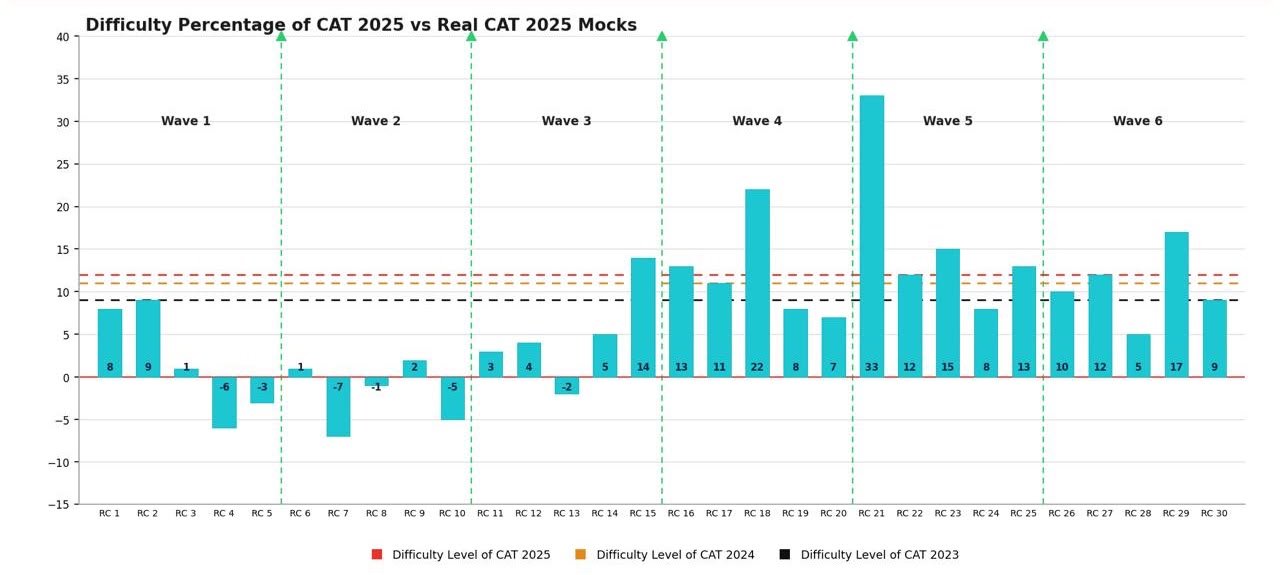
CATKing Real CAT Mocks are based on IIM Indore Pattern and live mock analysis is provided by the faculty.
CAT mock analysis should help you understand not just what went wrong, but what you should do differently next time. Review incorrect answers, questions you skipped and questions that took too long. Separate conceptual gaps from calculation errors, misreading and poor question selection. Then revisit the relevant concepts and practise similar questions.
CATKing provides live CAT mock analysis and the mocks are based only on the CAT pattern. Hence, you will experience real CAT interface when giving CATKing mocks
Prepare for each CAT section differently because the skills required are not the same.
- VARC:Read regularly and practise reading comprehension, para-based questions and verbal reasoning.
- DILR:Solve sets regularly, learn to identify approachable sets and practise interpreting data accurately.
- QA:Strengthen arithmetic, algebra, geometry and other relevant topics through concept revision and timed practice.
Take sectional tests to identify weaknesses, then use full-length mocks to practise switching between the three sections within the overall exam strategy.
For VARC, focus on understanding passages, identifying the author's argument and eliminating options using evidence from the text. For DILR, practise different set types and learn to judge which sets are worth attempting within the available time. For QA, build conceptual clarity before moving to timed problem-solving. Across all three sections, review incorrect answers and questions you could not solve. Improving your decision-making is just as important as learning new concepts.
The best CAT coaching in India depends on your learning style, budget, current preparation level and need for personal guidance. Compare faculty quality, course structure, mock tests, study material, doubt-solving support and the flexibility to revisit lessons. CATKing offers CAT preparation options that include live lectures, eBooks, mock tests and focused preparation guidance, mentorship and strategy sessions with CAT toppers.
Online coaching works well for students who want flexibility, recorded lessons and the ability to study from anywhere. Classroom coaching may suit students who learn better with a fixed timetable, face-to-face interaction and an established study routine. Neither format is automatically better. Compare teaching quality, doubt-solving access, mock analysis and consistency of support. Choose the format that helps you attend classes regularly, practise independently and stay accountable to your preparation plan.
CATKing students have delivered outstanding CAT results. A total of 521 CATKing students scored 90 percentile or above, including 70 students in the 99+ percentile, 273 students in the 95–98.99 percentile and 178 students in the 90–94.99 percentile.
That means 343 students scored 95 percentile or above, this range that opens the door to top B-schools.